Citizen-Triggered Accountability System
Fixing the Accountability Gap in American Government
Executive Summary
The United States has strong election systems—but weak correction systems once leaders are in office. When performance breaks down, action depends on the same political actors who may be unwilling to act.
The Citizen-Triggered Accountability System (CTAS) fixes that gap.
It gives citizens a disciplined way to trigger formal review and force timely action—without introducing instability or constant political churn. It doesn’t replace constitutional processes. It makes them work.
Gold Standard Governance Principle:
In high-performing systems, correction is not optional.
🔷 SECTION 2 — EXECUTIVE SUMMARY
Add Section: Text Block
Heading:
Executive Summary
Body:
The United States has strong election systems—but weak correction systems once leaders are in office. When performance breaks down, action depends on the same political actors who may be unwilling to act.
The Citizen-Triggered Accountability System (CTAS) fixes that gap.
It gives citizens a disciplined way to trigger formal review and force timely action—without introducing instability or constant political churn. It doesn’t replace constitutional processes. It makes them work.
Gold Standard Governance Principle:
In high-performing systems, correction is not optional.
🔷 SECTION 3 — THE PROBLEM
Add Section: Heading + Text
Heading:
Where the Current System Breaks Down
Intro Paragraph:
In any well-run organization, leadership problems are addressed quickly and directly. In national government, the opposite often occurs.
Bullet Block:
Action is optional
Congress can delay, avoid, or sidestep difficult decisions.Correction depends on insiders
Processes like Impeachment and the Twenty-fifth Amendment rely on political actors who may lack incentive to act.Citizens have no trigger mechanism
The public can vote every four years—but cannot force action in between.Time works against accountability
Delays dilute urgency and allow problems to persist.
Closing Paragraph:
This is not a partisan issue. It is a system design issue. When correction mechanisms are weak, performance suffers—regardless of who is in office.
🔷 SECTION 4 — THE SOLUTION
Add Section: Heading + Text
Heading:
A Practical Fix: Citizen-Triggered Accountability
Intro Paragraph:
The Citizen-Triggered Accountability System (CTAS) adds a missing layer to the system: a structured way for citizens to compel action without taking over the process.
Bullet Block with Explanation:
Citizens can trigger formal review
A national petition reaching a defined threshold forces the system to respond. This ensures serious concerns cannot be ignored.The process is automatic—not discretionary
Once triggered, the review must proceed. No committee, leader, or party can quietly bury it.Independent evaluation replaces political delay
A qualified review panel evaluates the issue within a defined time frame, focusing on facts, performance, and capacity.Congress must act on record
A formal vote is required within a fixed window. Action—or refusal to act—is visible and accountable.
Closing Paragraph:
CTAS does not hand power to the crowd. It introduces discipline into the system.
🔷 SECTION 5 — HOW IT WORKS
Add Section: Heading + Image + Text
Heading:
How the System Works
Instruction:
Insert the CTAS diagram here (use the PowerPoint graphic exported as image)
Add Text Below Image:
“The system moves through seven disciplined steps—each designed to eliminate delay and ensure visible action.”
1. Citizen Trigger
A broad national concern reaches a defined threshold of support, ensuring that only serious issues activate the system. This is not a casual petition—it reflects sustained, widespread attention across the country.
2. Petition Threshold Reached
Once the required number of verified signatures is achieved, the issue formally enters the system. At this point, the question is no longer whether to act, but how the system will respond.
3. Mandatory Process Begins
The process activates automatically. No political actor has the ability to delay, deflect, or quietly set the issue aside. This is the core shift: action becomes required, not optional.
4. Independent Review Panel
A qualified panel conducts a focused evaluation within a defined time frame. The goal is not political positioning, but clear assessment of performance, conduct, or capacity.
5. Public Report
Findings are released in full to the public. This creates a shared understanding of the issue and prevents selective interpretation or behind-the-scenes control of information.
6. Congressional Vote Required
Congress must formally respond within a fixed period. Members are required to take a position—either to act or to reject the findings—on the record.
7. Public Accountability
Every decision is visible. Votes are recorded, and responsibility is clear. The outcome feeds directly back into the democratic process, where citizens can respond accordingly.
COMBINE BELOW INTO ABOVE TEXT
Step-by-step flow:
1. Citizen Trigger
A national petition reaches a high threshold with broad geographic support. This ensures only serious concerns activate the system.2. Mandatory Activation
The process begins automatically. There is no option to delay or ignore.3. Independent Review Panel
A rotating panel of legal, medical, and ethics experts evaluates the issue within a fixed timeline.4. Public Report
Findings are released in full, creating transparency and shared understanding.5. Required Congressional Vote
Congress must formally act within a defined period—no deferral.6. Public Accountability
Every vote is recorded and visible. The outcome becomes part of the democratic process.
🔷 SECTION 6 — WHY THIS WORKS
Add Section: Heading + Bullet + Text
Heading:
Why This Approach Works
It forces action without chaos
The system moves forward automatically—but within structured boundaries.It restores citizen leverage
The public gains a meaningful way to trigger accountability.It preserves constitutional stability
Existing processes remain intact. CTAS strengthens them rather than replacing them.It introduces time discipline
Fixed timelines prevent drift and delay.
Short Paragraph:
In management terms, CTAS closes a critical gap: it ensures that when performance issues arise, the system responds—consistently and visibly.
🔷 SECTION 7 — CURRENT VS. GOLD STANDARD
Add Section: Table or Columns
Heading:
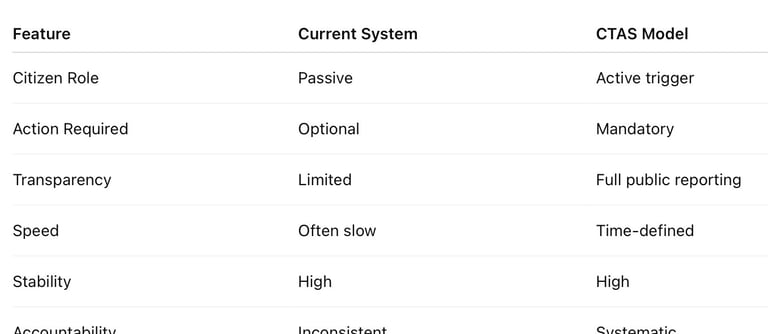
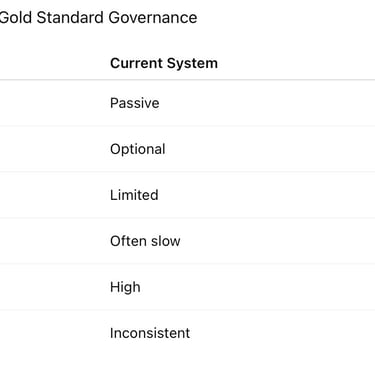
Current System vs. Gold Standard Governance
FeatureCurrent SystemCTAS ModelCitizen RolePassiveActive triggerAction RequiredOptionalMandatoryTransparencyLimitedFull public reportingSpeedOften slowTime-definedStabilityHighHighAccountabilityInconsistentSystematic
🔷 SECTION 8 — CLOSING
Add Section: Text Block
Heading:
A Better Way to Think About Governance
Body:
This model is not about politics. It is about performance.
In every high-functioning system—business, healthcare, military—there are clear mechanisms to identify problems and act on them. Government should be no different.
The Citizen-Triggered Accountability System offers a practical step toward that standard.
Gold Standard Governance™
Not about who is right—about what works.
🔷 SECTION 9 — CALL TO ACTION
Add Section: Small Text / Button
Heading:
Continue Exploring
Options:
Learn more about Selection vs. Correction
Explore additional Gold Standard Governance models
Share and discuss these ideas